
MACHINE INTELLIGENCE NATIVE DESIGN
Intelligence, compiled.
One language from prototype to production AI. MIND brings compile-time tensor safety, compile-time autodiff, and deterministic execution to AI development — catching shape bugs before runtime, eliminating training overhead, and delivering auditable builds for regulated industries.
1fn main() {2 // 2x2 input tensor3 let x: Tensor<f32, 2, 2> = [[1.0, 2.0], [3.0, 4.0]];45 // Parameter tensor with compile-time shape6 let w: Tensor<f32, 2, 2> = randn();78 // Autodiff-ready computation9 let y = relu(x @ w);1011 print(y);12}
Shapes and dtypes are known at compile time, so invalid tensor math never reaches production.
The problems we solve
Today's AI stacks are fragmented: Python for research, C++/CUDA for performance, separate runtimes for cloud and edge. Models fail in production with runtime shape mismatches, training loops carry per-iteration autodiff overhead, and regulated industries can't get reproducible builds.
Runtime shape bugs
Tensor shape and dtype errors surface in production, not during development. MIND catches these at compile time with static tensor types.
Fragmented toolchains
Python for prototypes, C++ for production, glue code everywhere. MIND gives you one language from research to deployment.
Non-deterministic builds
Can't reproduce training runs or audit model provenance for compliance. MIND delivers 100% bit-identical reproducible builds and deterministic execution mode.
What MIND does
A programming language and compiler stack built specifically for AI and numerical computing — tensor-native types, static shape checks, automatic differentiation, and MLIR-powered code generation, all in one toolchain.
Tensor-native and statically checked
Shapes, dtypes, and device semantics live in the type system, catching whole classes of bugs at compile time instead of at runtime.
Compile-time autodiff
Gradients computed once during compilation, not on every training iteration. No runtime tape overhead.
Deterministic execution & auditable builds
100% bit-identical reproducible builds verified via cryptographic hashing. Every compilation produces identical output — critical for regulated ML and model certification.
How it works
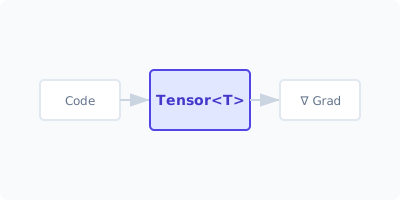
Language & type system
A Rust-inspired language with first-class tensors, deterministic memory management, and built-in automatic differentiation.
- Shape- and dtype-aware tensors
- Differentiable functions with compiler-generated gradients
- Device annotations for CPU, GPU, and future accelerators
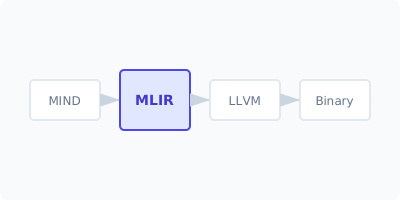
Compiler & runtime
Source code is lowered into a custom MLIR dialect and then into LLVM IR, producing optimized binaries and modular runtimes for CPU and accelerators.
- MLIR-based IR for tensor and graph optimizations
- LLVM for hardware-specific code generation
- Lean runtime modules for AOT, JIT, and embedded targets
Performance That Matters
MIND optimizes both compilation and runtime — fast iteration during development AND production performance when it matters.
Fast Compilation
Compile ML programs in ~38 microseconds. Verified benchmarks show 53-247× faster compilation than PyTorch 2.0, and 12,000-339,000× faster than Mojo.
Deterministic Mode
100% bit-identical builds verified via SHA256 cryptographic hashing. Every compilation produces identical output — essential for regulated industries and model certification.
Low-Overhead Autodiff
Gradients computed once during compilation, not on every training iteration. 1,300-11,000× more efficient than runtime autodiff over 1000 iterations.
Who is MIND for?
Regulated ML & audit trails
Healthcare, finance, autonomous systems — industries where model provenance and reproducibility aren't optional. MIND's deterministic builds deliver auditable ML.
Platform teams scaling ML infrastructure
Standardize on one language for research and production. Eliminate glue code between notebooks, services, and accelerators.
Edge & embedded deployment
Compile to lean, deterministic binaries that fit into constrained environments where interpreters and heavy runtimes are not an option.
Open core + enterprise

Community Edition (Apache 2.0): The compiler and language are open source and ready for experimentation.
Commercial runtime + hosted offerings from STARGA, Inc.: Deterministic execution mode, audit logs, compliance tooling, and hosted control plane with SLA-backed support.